
 Indonesia

Strategic Environmental Assessment (SEA) Regional Medium-Term Development Plan (RPJMD), South Kalimantan Province 2025-2029
The Strategic Environmental Assessment (SEA) of the South Kalimantan Provincial Medium-Term Development Plan (RPJMD) for 2025-2029 aims to ensure the integration of sustainable development principles into regional development policies, plans, and programs (KRP). As a buffer zone for the Capital City of Nusantara (IKN), South Kalimantan Province faces the challenge of shifting its economic dependence from natural resource-based sectors, such as mining, towards a sustainable green economy. This step is in line with the national commitment to achieve net zero emissions by 2050. This KLHS was prepared based on national regulations, such as Government Regulation No. 46 of 2016, and adopts relevant Sustainable Development Goals (SDGs) indicators to achieve a balance between economic and social development and environmental preservation.
The objectives of the South Kalimantan Province RPJMD KLHS for 2025-2029 are: 1) To ensure that development policies in South Kalimantan support the achievement of the TPB through the integration of environmental carrying capacity and sustainability; 2) To provide strategic direction in the transition to low-carbon development and a green economy; 3) To improve the region’s climate resilience to disaster risks related to climate change.
The Strategic Environmental Assessment (SEA) plays a fundamental role in ensuring the integration of sustainable development principles into development policies, plans, and programs (KRP) in South Kalimantan Province for 2025-2029. The urgency of SEA in the Regional Medium-Term Development Plan (RPJMD) lies in its function to identify potential environmental risks arising from development, while offering strategic solutions so that development goals can be achieved in a balanced manner. SEA recommendations are very important to ensure that development not only improves the welfare of the community, but also preserves the environment. The analysis of carrying capacity and capacity, achievements against Sustainable Development Goal (SDG) indicators, and achievements of Regional Apparatus Organizations (OPD) provide a strong foundation for the formulation of more specific and targeted recommendations.
Based on the results of the study, there are several analytical results such as carrying capacity and capacity analysis, TPB indicator achievement analysis, and OPD achievement analysis. The analysis of the carrying capacity and capacity of the environment in South Kalimantan Province was carried out using an ecoregion and ecosystem services approach. The results of this analysis show that the environmental potential of the region must be optimised wisely to achieve sustainable development targets. A deep understanding of carrying capacity and environmental capacity is important for determining sustainable development scenarios, both with and without additional efforts. Thus, local governments can plan the efficient use of natural resources and avoid unnecessary environmental damage.
T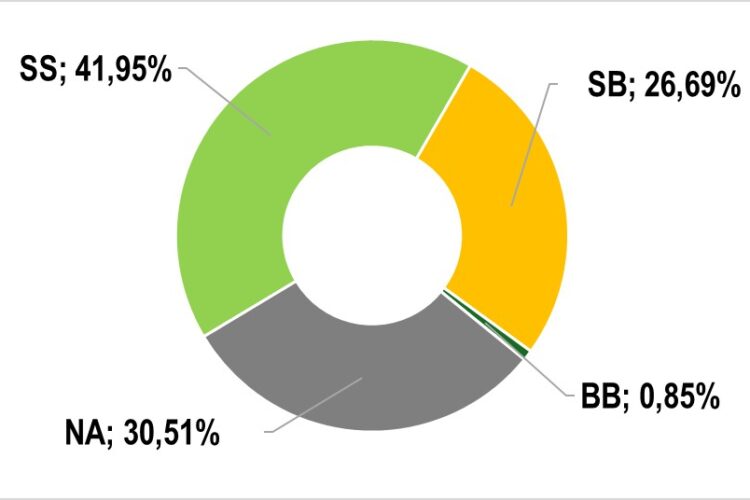 he analysis of SDG indicator achievements in South Kalimantan Province shows that 41.95% of indicators have met the set targets or are categorized as Implemented and Achieved (SS). Meanwhile, 26.69% of indicators have been implemented but have not yet reached the expected targets or are categorized as Implemented but Not Achieved (SB). On the other hand, 0.85% of indicators have not been implemented at all and have not reached the target (Not Implemented and Not Achieved/BB). In addition, 30.51% of indicators do not have available data or reports and are categorized as No Data (NA). This analysis covers several key pillars as a basis for evaluation.
The analysis of OPD achievements against SDG indicators shows that Regional Apparatus Organizations (OPD) play a key role in achieving SDGs in South Kalimantan Province. The involvement of OPDs in various social, economic, environmental, and governance pillars reflects their contribution to achieving sustainable development goals. The evaluation of OPD achievements against SDG indicators shows that although many indicators have been achieved, there are still some that require further attention and effort.
In determining the most strategic issues, a comparison was made between the results of the TPB analysis, global and national issues, and FGDs, resulting in the identification of five (5) most strategic issues, namely:
- Disaster Resilience and Climate Change,
- Land Use Change,
- Green Economy, and
- Food Security.
There are four recommendations for the 2025-2029 South Kalimantan Provincial Medium-Term Development Plan (RPJMD), namely:
- Improving the quality of human resources to be superior and competitive
- Improving ecological and food security and resilience to disasters and climate change
- Strengthening the foundation for productive, inclusive, equitable, and sustainable economic transformation
- Enhancing regional stability