
 Indonesia
Preparation of the 2025-2045 Regional Long-Term Development Plan (RPJPD) for the City of Bogor
Over the next 20 years, the City of Bogor, as part of the Jabodetabek National Activity Center, will face strategic challenges in the economic, social, and cultural aspects. The demographic bonus that Bogor City will have in the next 20 years in the form of productive human resources must be prepared. The potential of Bogor City as a heritage city, a city of science, creative economy, tourist destination, and a city with green landscapes, is the basic capital for development in order for Bogor City to be more advanced and sustainable in 2045. Poverty, unemployment, and inequality are still issues that must be resolved.
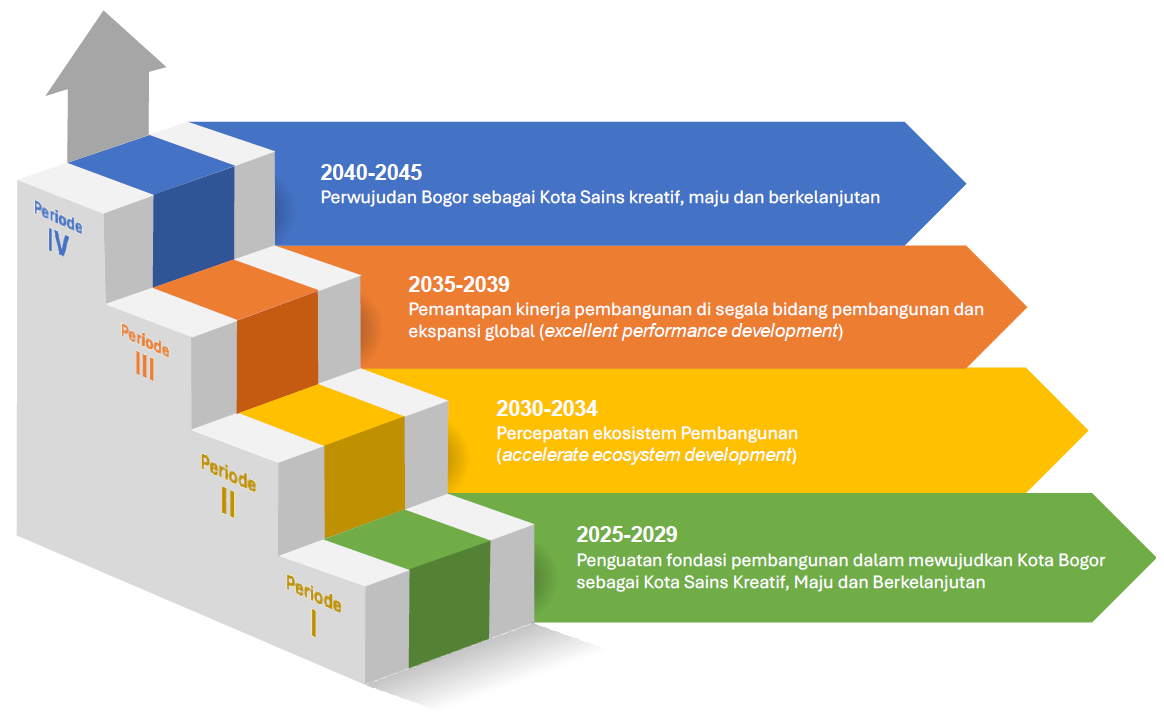
The Regional Long-Term Development Plan (RPJPD) is a regional development plan for a period of 20 (twenty) years. To date, Bogor City has an RPJPD for 2005-2025, which was established through Bogor City Regional Regulation No. 7 of 2009 and will expire in 2025. Therefore, it is necessary to prepare an RPJPD document for 2025-2045 to achieve Bogor City’s vision for 2045.
The purpose and objective of the preparation of the 2025-2045 Bogor City RPJPD document is to provide an overview of the direction of Bogor City’s development for the next 20 (twenty) years in an effort to support the achievement of national development goals and to realize the welfare of the community.
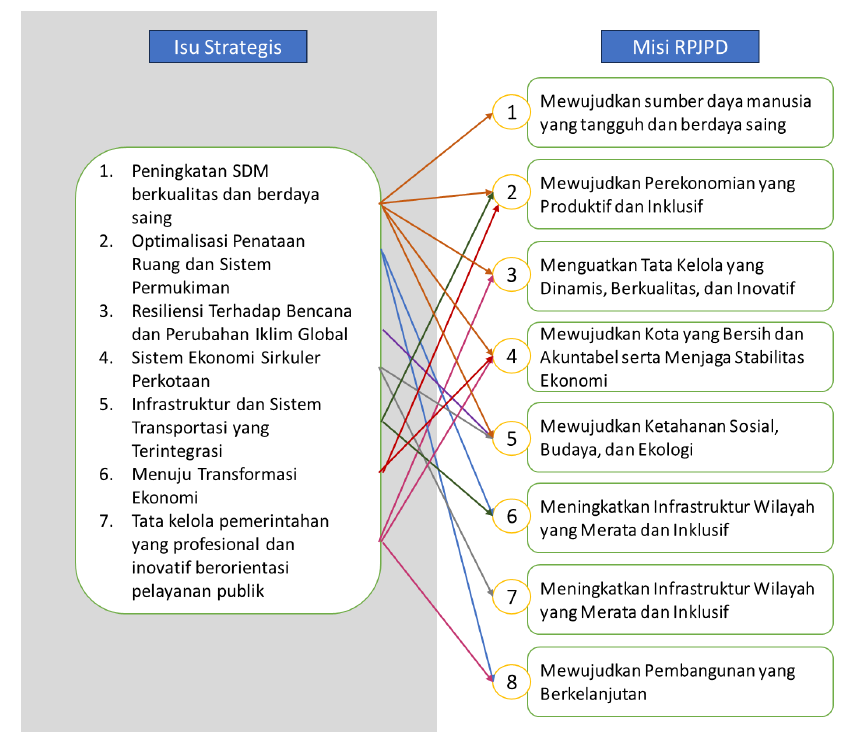
Issues that need to be addressed include human resource development, economic development, infrastructure and environmental development, and good governance.
 There are five main pillars that are key to the successful implementation of the Bogor City RPJPD:
- First, consistency and synchronization of development planning with funding through the application of an integrated Logical Framework from the RPJPD document to the operational level. A thematic, spatial, holistic, and integrative approach ensures that each development program is relevant to the objectives that have been set.
- Second, continuous and participatory development control, supported by an integrated electronic system and good data governance. Control is exercised at the planning and implementation stages through systematic monitoring, evaluation, and risk management to ensure the achievement of development goals.
- Third, public communication that upholds the principles of “no one left behind” and “meaningful participation.” Openness, transparency, and ease of access to information will encourage active community participation in the planning, implementation, and control of development.
- Fourth, optimization of development financing through diversification of funding sources from the public and non-public sectors. Strengthening cooperation with the private sector through Public-Private Partnership (PPP) schemes, creating a conducive investment climate, and developing green financing will expand the basis for regional development financing.
- Fifth, strengthening investment management through the role of the Bogor City Investment and One-Stop Integrated Service Agency (DPMPTSP) in creating an efficient, transparent, and supportive business ecosystem, as well as providing excellent service to investors to encourage sustainable economic growth.
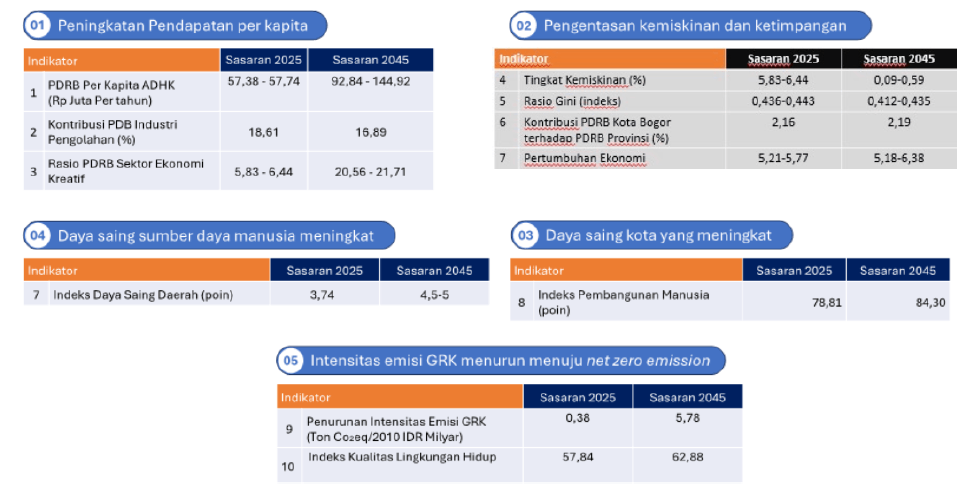 By consistently and sustainably integrating all these elements, the Bogor City Government, together with all stakeholders, will be able to realize the Vision of Bogor City 2045 as a developed, prosperous, inclusive, and sustainable city for all levels of society. This success requires long-term commitment, close collaboration, and innovation in regional development governance.