
 Indonesia
Final Draft of the 2025-2045 RPJPD for West Aceh Regency
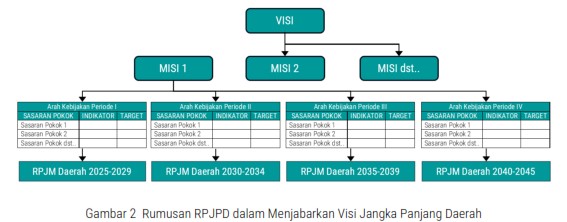
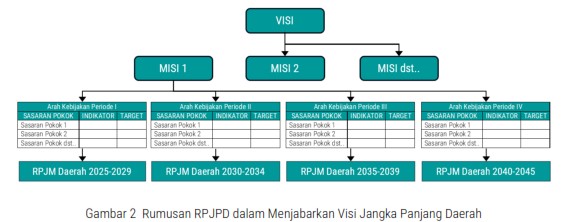
The Regional Long-Term Development Plan (RPJPD) is an elaboration of the vision and mission, policy directions, and key objectives of long-term regional development for 20 (twenty) years, prepared in accordance with the National Long-Term Development Plan (RPJPN) and the Regional Spatial Plan (RTRW). The 2025-2045 RPJPD is aimed at supporting the achievement of national development goals in realizing equitable regional community welfare by placing people as the object and subject of development. This is based on the principle of human rights that in realizing equitable welfare, the Regional Government must focus on the community as the object and subject of development.
The Aceh Barat Regency Long-Term Development Plan (RPJPD) for 2025-2045, which contains the vision, mission, policy directions, and main objectives of the region, serves as a guideline for all stakeholders in the implementation of development in Aceh Barat Regency over the next 20 years. This RPJPD also serves as a reference and guideline for prospective regional heads in formulating their vision, mission, and priority programs, which will form the basis for the preparation of the Regional Medium-Term Development Plan (RPJMD) of West Aceh Regency, which has a five-year timeframe, and the Regional Government Work Plan (RKPD) of West Aceh Regency, which has a one-year timeframe.
The preparation of the Final Draft RPJPD includes: a) analysis of the general overview of regional conditions; b) analysis of regional development issues; c) review of other development planning documents; d) analysis of strategic issues for long-term development; e) formulation of regional vision and mission; and f) formulation of regional policy directions and key objectives.
The general objective of this activity is to evaluate the results of the RPJPD and prepare the final draft of the RPJPD for the next period. The specific objectives are: 1) To identify the conditions of West Aceh Regency through various aspects of development; 2) To formulate strategic issues and problems related to the development of West Aceh Regency; 3) To formulate the long-term development vision and mission of West Aceh Regency; and 4) To formulate policy directions and key regional objectives.
The success of Aceh Barat Regency’s long-term development in realizing its vision as an “Islamic, Advanced, and Sustainable” regency needs to be supported by a strong and democratic local leadership committed to responsive, adaptive, and integrity-based governance, with the active participation of all stakeholders in development. To achieve the vision of West Aceh Regency as an “Islamic, Advanced, and Sustainable” regency, it is manifested in 8 missions, namely as follows: (1) Realizing social transformation of the community towards improving the quality of human resources; (2) Realizing economic transformation in improving the welfare of the community based on economic independence; (3) Realizing the transformation of governance and supporting stability and conduciveness; (4) Realizing the practice of Islamic law through law enforcement; (5) Realizing West Aceh that is socially, culturally, and ecologically resilient; (6) Realizing equitable development throughout West Aceh in accordance with the potential of the region; (7) Optimizing the use of natural resources while paying attention to the preservation of natural resources and the environment; (8) Realizing sustainable development in West Aceh. Each mission is explained through policy directions and strategic objectives.
Strategies and policies play a very important role in achieving development goals. They provide guidance on the concrete steps that need to be taken to achieve development goals. They form the basis for decision-making and action at all levels of government. With well-directed strategies and policies, resources can be used more efficiently and effectively. They help avoid waste of resources and ensure that development efforts are focused on the most important issues. Strategies and policies facilitate coordination between institutions and sectors. They help integrate various development initiatives and programs to work synergistically towards common goals.
Through sustainable development policies, strategies and policies help ensure that economic growth and social development do not harm the environment and the future of future generations. Strategies and policies can create mechanisms to involve the community in the development process. By involving stakeholders, development goals can become more relevant and accepted by the community. Strategies and policies assist in the identification, evaluation, and mitigation of risks that may arise during the implementation of development projects. This helps to avoid potential obstacles and failures in achieving objectives. With policies that support human development, such as education and health, strategies and policies help to improve the social welfare of the community.
Through policies that support the economic sector, strategies and policies help improve the competitiveness of a region or country in the global context. This includes infrastructure development, investment, and trade policies. Strategies and policies can be designed to ensure the fair distribution of development benefits, reducing social and economic disparities among various groups in society. By establishing policies that support accountability and transparency, governments can build public trust and avoid corrupt practices that can undermine development. With good strategies and policies in place, a development entity has a more solid foundation to achieve its goals, ensure sustainability, and have a positive impact on society as a whole.