The European Union Deforestation Regulation (EUDR) aims to reduce EU consumption of products that contribute to deforestation and forest degradation. Companies placing relevant products on the EU market must ensure that their commodities are legally produced in accordance with their respective national laws and produced without deforestation after 2020.
This study aims to provide information on existing relevant Indonesian legislations to be considered by operators when doing their due diligence and provide references for supply chain actors to comply with relevant Indonesian regulations in the context of EUDR requirements. The scope of this study is the laws and regulations, both at the national and sub-national levels, that are relevant to the cocoa, coee, and natural rubber commodities, with additional coverage on the laws and regulations relevant to the timber sector.
The methodology used in this study involved desk review research, interviews, and focus group discussions with stakeholders. This study is of a quasi-academic, informative, and non-concluding nature. The EU does not provide any guidance on the specific laws and regulations operators and traders must follow in Indonesia. Per the regulation, it is for the operators to ensure that relevant laws and regulations in the country of production are respected in the context of their due diligence obligations and for the competent authorities conducting checks on operators to assess whether operators’ due diligence system and relevant documentation are compliant with legal production of relevant products. As such, this legality study only serves to help guide the due diligence process; it is neither exhaustive nor binding.
As stated in the EUDR (Article 2 (40)), “‘relevant legislation of the country of production’ means the laws applicable in the country of production concerning the legal status of the area of production in terms of: as (a) land use rights; (b) environmental protection; (c) forest-related rules, including forest management and biodiversity conservation, where directly related to wood harvesting; (d) third parties’ rights; (e) labour rights; (f) human rights protected under international law; (g) the principle of free, prior and informed consent (FPIC), including as set out in the UN Declaration on the Rights of Indigenous Peoples; (h) tax, anti-corruption, trade and customs regulation”. Some key legislation to consider is as follows:
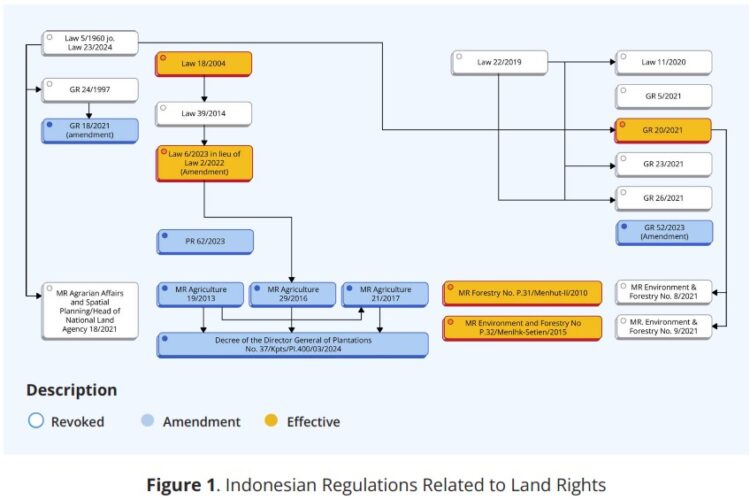
On land use rights, Indonesia follows a state-based land tenure system under Law No. 5/1960, where land is state-controlled but plantation actors can obtain cultivation rights (Hak Guna Usaha or HGU) for up to 35 years, extendable by another 25 years. These rights must be registered and can be revoked if the land is left unused. Plantation land use is subject to spatial planning obligations, with maximum limits defined by commodity type: rubber (23,000 ha), cocoa (13,000 ha), and coee (13,000 ha).
In terms of environmental protection, multiple laws impose clear obligations on plantation operators to safeguard biodiversity, mitigate environmental harm, and maintain sustainable land use. For example, Law No. 32/2009 and Law No. 22/2019 emphasise responsible cultivation and ecosystem protection. Environmental damage, especially through land clearing or fire, is addressed through Law No. 39/2014 and GR 22/2021. The use of agrochemicals, particularly pesticides, is tightly regulated, requiring registration with the Ministry of Agriculture under the ministry’s Regulation 43/2019 and compliance with safety and training protocols. Waste management is governed under Law 32/2009 and GR 22/2021 while water and soil protection are addressed through Law 17/2019, Law 37/2014, and Law 41/1999.
With respect to third-party rights, Law 39/2014 requires plantation companies to engage in inclusive and mutually beneficial partnerships with smallholders and local communities. Companies must allocate 20% of their cultivated area to community plantations and are obligated to provide social facilities and human resource development programs. These obligations are further supported by Law 19/2013 on the Protection and Empowerment of Farmers.
In the area of labour rights, law 1/1970 covers occupational safety and health, while Law 21/2000 guarantees unionisation rights and protection from discrimination. Workers are entitled to fair wages, social security, rest periods, maternity leave, and religious accommodations. Child labour is strictly prohibited, and special considerations are extended to workers with disabilities.
On human rights, the 1945 Constitution and Law 39/1999 guarantee a range of rights, including the right to life, health, education, personal freedom, decent work, and protection for vulnerable groups such as women, children, and persons with disabilities.
Indonesia’s tax and governance regulations align with EUDR expectations around transparency, integrity, and anti-corruption. Taxes aecting plantation actors include income tax (PPh), VAT (PPN), and land/building tax (PBB), governed by Laws 6/1983, 7/1983, and 7/2021. Anti-corruption is addressed throughLaw 31/1999 and the role of the Corruption Eradication Commission (KPK), reinforced by public whistleblower protections under GR 43/2018. Trade and customs activities are regulated under Law 7/2014 and GR 29/2021, ensuring standards and licensing are met, particularly for exports. Timber exports are further governed by Presidential Decrees 48/1977 and 39/1979, which aim to stabilise domestic industry development.
Data protection is recognised as a constitutional right, codified in Law 27/2022. This law outlines data subject rights, including consent, access, correction, and deletion of personal data. Plantation geospatial data, including HGU maps, is considered public information based on Law 14/2008 and confirmed by a Supreme Court ruling, unless specifically exempted for national security.
Finally, Indonesia’s framework for traceability is regulated through GR 26/2021 and Ministry of Agriculture Regulation 53/2018, requiring agricultural information systems that support traceability. For timber, Indonesia implements the SILK (Sistem Informasi Legalitas Kayu) platform under SVLK, which allows public access to data on timber legality and supply chain transparency.
In conclusion, while Indonesia’s regulatory landscape presents a comprehensive framework for compliance with the EU Deforestation Regulation (EUDR), the complexity of overlapping laws, multiple responsible ministries, and varying land tenure systems pose significant challenges, particularly concerning land rights and Indigenous peoples’ rights. Plantation business actors must prioritise legal land use verification, community consultation and respect customary land claims. Equally, due diligence processes must ensure traceability, inclusion of smallholders, and adherence to environmental and labour standards.
URL: https://zerodeforestationhub.eu/study-on-eudr-legality-requirements-in-the-context-of-indonesia/